
How Does The Google Ranking System Works in 2026?
Why does one website appear at the top of Google while another, covering the same topic, barely gets noticed?
The answer isn't simply keywords, backlinks, or website speed. Google uses multiple automated systems to understand what people search for and decide which results are most useful.
Here's how Google's ranking systems work, what influences search results, and what website owners should understand about ranking changes and AI search in 2027.
What Is Google's Ranking Algorithm?
Google's ranking algorithm is often described as a single formula that decides where websites appear in search results.
In reality, Google uses several automated ranking systems working together.

These systems analyze information from hundreds of billions of webpages and other content to find results that match a person's search.
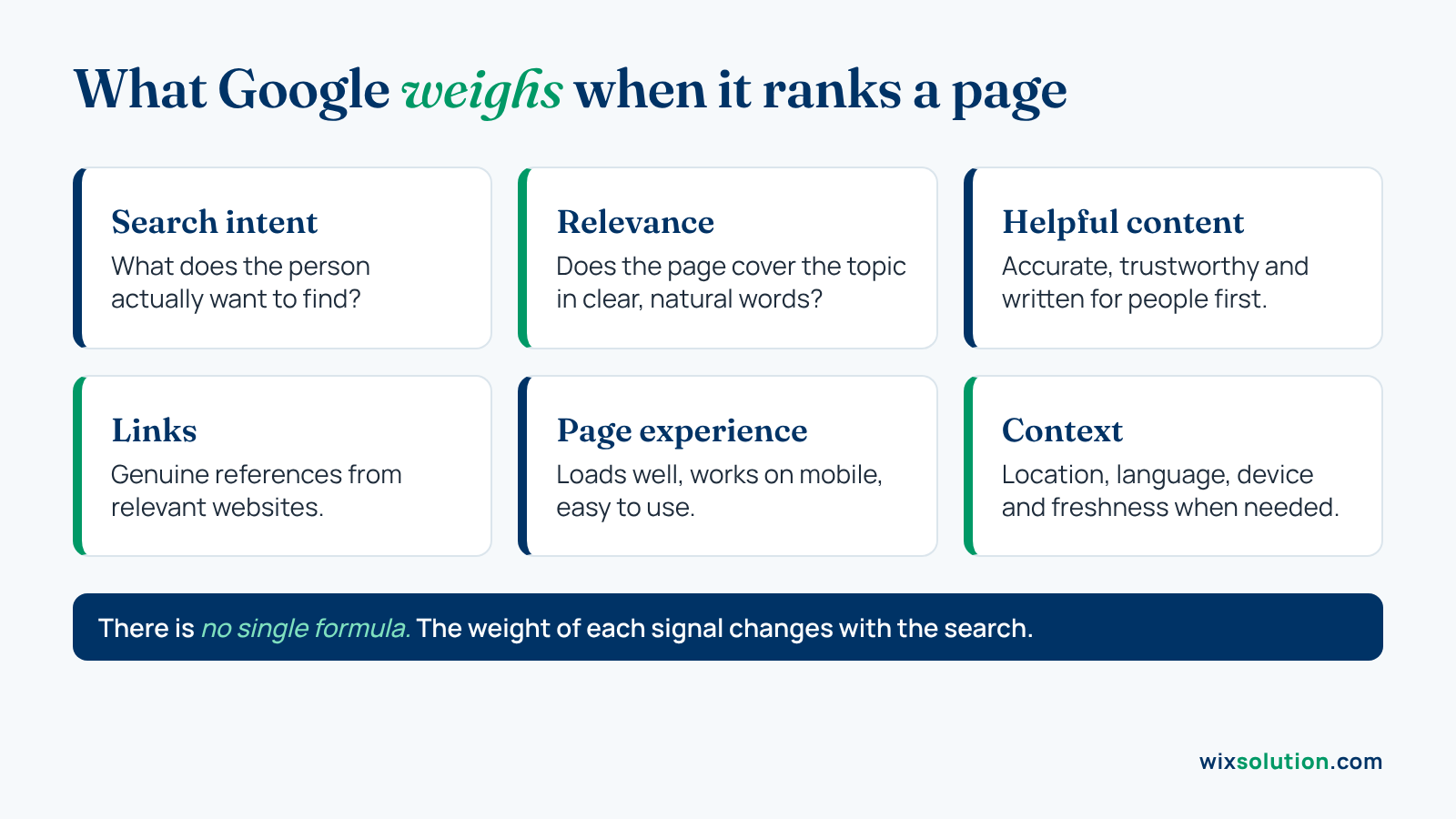
Google considers factors such as the meaning of the query, content relevance, reliability, page usability, and the searcher's location.
Not every factor carries the same importance for every search.
For example, someone searching for breaking news probably wants recent information. Someone searching for instructions on repairing a bicycle may find a detailed tutorial from several years ago just as useful, provided the information is still accurate.
Google explains these differences in its official guide to Search ranking systems.
How Google Search Works: Crawling, Indexing, and Ranking
Before a webpage can appear in Google Search, Google needs to discover and process it.
This happens through three main stages.
1. Crawling: Google Discovers Your Pages
Google uses automated programs called crawlers, including Googlebot, to discover webpages.
These crawlers follow links, revisit known pages, and use other discovery methods, including XML sitemaps.
For example, if you publish a new blog post and link to it from an existing page, Google may discover it by following that link.
However, discovery doesn't guarantee that Google will crawl the page immediately.
2. Indexing: Google Processes Your Content
After crawling a page, Google analyzes its content to understand what it contains.
That can include text, images, videos, and other information.
Google may then store the information in its search index.
But not every crawled page gets indexed.
A page might be excluded because it's a duplicate of another URL, contains a noindex instruction, has technical problems, or doesn't meet Google's indexing considerations.
You can use Google Search Console to investigate whether your important pages are indexed.
3. Ranking: Google Chooses Relevant Results
When someone searches, Google's systems look for suitable results from its index.
They evaluate which pages are likely to answer the query and determine how to present them.
Google doesn't simply display websites in the order they were published or indexed.
It assesses relevance, quality, context, and other signals to decide which information may be most useful.
That's why being indexed and ranking well are two different things.
A page may be indexed without appearing prominently for the keywords you're targeting.
You can read more about these stages in Google's official explanation of how Search works.
How Does Google Decide Which Pages Rank Higher?
Google doesn't publish the exact formula or weight of every ranking signal.
However, its documentation explains several important areas that help determine search results.
Understanding these areas is more useful than trying to follow an unverified list of hundreds of ranking factors.
Google Tries to Understand Search Intent
Before choosing results, Google needs to understand what someone wants.
Consider these searches:
"Why is my dishwasher not draining?"
"Dishwasher repair in Leeds"
"Best dishwasher under £500"
All three involve dishwashers, but the searchers want different information.
The first person wants troubleshooting advice. The second wants a local repair service. The third is comparing products.
Google tries to match each query with the appropriate kind of content.
This is why a helpful article doesn't necessarily rank for a service-related search, even when both discuss the same topic.
For website owners, the lesson is straightforward: understand what visitors want before creating or optimizing a page.
If someone is looking to hire a service, give them a page explaining that service. If they're trying to learn something, provide a useful explanation.
Content Relevance Matters
Google analyzes page content to understand whether it relates to the search.
Words appearing in titles, headings, and body text can provide useful context.
But repeating a keyword doesn't automatically make a page more relevant.
Google can also understand relationships between words and concepts.
For example, someone might search for "how to stop a tap dripping," while a helpful article uses the phrase "fix a leaking faucet."
The wording is different, but the underlying problem is similar.
Your content should use the language customers naturally understand and cover the information they need.
You don't have to repeat the same keyword in every paragraph.
For a detailed walkthrough of improving titles, headings, and page content, see our on-page SEO guide for Wix websites.
Helpful and Trustworthy Content Is Important
Google's ranking systems aim to prioritize information that appears helpful and reliable.
That includes evaluating signals associated with the quality of the content and the credibility of its sources.

For example, someone researching a medical condition needs information they can trust. A misleading explanation could have serious consequences.
Google places particular importance on reliability for topics that may affect people's health, finances, safety, or well-being.
For everyday business content, accuracy still matters.
A repair company explaining how appointments work should provide correct information. A website tutorial should reflect the current interface rather than relying on outdated screenshots.
Original knowledge can also make content more useful.
If you've tested a process, explain what you learned. If you're describing a service, include details that help customers understand what happens when they hire you.
Google's people-first content guidance recommends creating content that meets visitors' needs rather than publishing material primarily to attract search traffic.
What Is E-E-A-T, and Does It Affect Rankings?
E-E-A-T stands for Experience, Expertise, Authoritativeness, and Trustworthiness.
Google uses this framework when discussing how to evaluate content quality.
Here's what those terms generally mean:
Experience: Whether the content demonstrates relevant firsthand knowledge.
Expertise: Whether the creator understands the subject.
Authoritativeness: Whether the creator or source is recognized as reliable within the topic.
Trustworthiness: Whether the information is accurate, honest, and dependable.
Trust is particularly important.
However, E-E-A-T isn't a direct ranking factor or a score assigned to every website.
Google uses different systems and signals to identify qualities associated with trustworthy information.
Its human search quality raters also use E-E-A-T when evaluating search result quality, but those ratings don't directly determine the rankings of individual pages.
What Does E-E-A-T Look Like on a Website?
Suppose two websites explain how to connect Google Analytics to Wix.
One provides a few generic instructions without showing where the settings are located.
The other includes accurate instructions, relevant screenshots, links to official documentation, and explanations of common problems.
The second guide gives readers more ways to understand and verify the process.
That doesn't guarantee it will rank higher, but it demonstrates what useful, experience-based content can look like.
You don't need to call yourself an expert repeatedly. Show relevant knowledge through the information you provide.
How Do Backlinks Influence Google Rankings?
Backlinks are links from other websites to yours.
Google has used links as part of its ranking systems since its early days.
One of its best-known systems is PageRank, which analyzes relationships between webpages through links.
PageRank has changed considerably over time, but Google confirms that it remains part of its core ranking systems.
Links can help Google understand which pages are connected and which sources may be useful for particular topics.
However, backlinks aren't all equally valuable.
A genuine reference from a relevant industry publication may provide more useful context than a large collection of links from unrelated websites.

That doesn't mean you should chase a particular number of backlinks.
A better approach is to create resources worth referencing, develop genuine industry relationships, and make your website useful to the people you want to reach.
Avoid buying links intended to manipulate rankings or joining artificial link schemes.
Is Domain Authority a Google Ranking Factor?
Domain Authority, commonly abbreviated as DA, is a metric developed by Moz.
Other SEO tools provide their own authority-related scores.
These metrics can be useful for comparing websites within a tool, but they're not Google's official ranking scores.
Google uses its own systems to evaluate pages and links.
A website with a high third-party authority score won't automatically outrank a smaller website for every search.
Focus on relevance, useful content, and legitimate links rather than trying to increase a tool's score for its own sake.
How Do Page Speed and User Experience Affect Rankings?
Google considers aspects of page experience when evaluating search results.
A page that loads reasonably quickly, works on mobile, and allows visitors to read its content comfortably provides a better experience than one that's difficult to use.
Google's Core Web Vitals measure aspects of loading performance, responsiveness, and visual stability.
You can check these using Google PageSpeed Insights.
However, good performance scores don't guarantee higher rankings.
Google's page experience documentation explains that its systems generally aim to show the most relevant content, even when a page doesn't have an ideal user experience.
That distinction matters.
If your content doesn't answer the searcher's question, achieving a perfect speed score won't necessarily solve the ranking problem.
For Wix website owners, it's worth maintaining good technical performance while paying equal attention to useful content and straightforward navigation.
Our technical SEO guide covers the implementation side in more detail.
Why Fresh Content Doesn't Always Rank Better
You may have heard that Google prefers recently published content.
That's only partly true.
Google has ranking systems designed to recognize when a search calls for fresh information.
For example, someone searching for a recently released software update probably needs current documentation.
Someone searching for the history of the printing press may find an older, well-researched resource perfectly suitable.
The importance of freshness depends on the query.
Simply changing the publication date from 2026 to 2027 won't necessarily improve a page's ranking.
What matters is whether the information still meets the reader's needs.
Update content when instructions change, new evidence becomes available, or important information is missing.
You don't need to rewrite an accurate article just to make it appear newer.
Why Search Results Change Depending on Location
Google doesn't show identical results to everyone.
Location, language, device, and the nature of the query can influence what appears.
For example, someone searching for "bicycle repair" in Bristol may see nearby repair businesses.
A person making the same search in Manchester will probably see different local results.
Google also uses separate systems for certain search features, including local results and news.
For businesses serving customers in specific areas, this means national website rankings don't tell the whole story.
A business might have limited visibility for a broad national query while still appearing for relevant searches near its location.
If local search matters to your business, our local SEO best practices guide explains how Google Business Profile, business information, and location-relevant website content fit together.
How Does Google Use AI in Its Ranking Systems?
Artificial intelligence has been part of Google Search for years.
Several of Google's documented ranking systems use AI to interpret queries and understand content.
RankBrain
RankBrain helps Google understand relationships between words and concepts.
It supports matching useful content to searches even when the webpage doesn't contain the exact words used in the query.
BERT
BERT helps Google understand how words work together to express meaning.
This is useful when a small change in wording affects what someone is asking.
Neural Matching
Neural matching helps Google identify relationships between concepts in searches and webpages.
It can recognize relevant information beyond simple keyword matches.
Passage Ranking
Google also uses passage ranking to identify useful sections within longer webpages.
For example, an extensive guide may contain a section that directly addresses a specific question, even though the entire article covers a broader topic.
Google's systems can use that section to better understand the page's relevance.
These systems don't mean keywords no longer matter. Clear wording still helps. But Google can interpret meaning in ways that go beyond finding exact keyword matches.
You don't need to optimize separately for RankBrain, BERT, or neural matching.
Write clearly, answer relevant questions, and organize information so readers can understand it.
How Do AI Overviews and AI Mode Change Google Search?
Google Search now includes AI-generated experiences such as AI Overviews and AI Mode.
Instead of only presenting traditional search results, these features can summarize information and provide supporting links.
AI Overviews can help users understand a topic quickly, while AI Mode supports more detailed questions and comparisons.
These systems may retrieve information from multiple related searches to develop their responses.
That means a user may discover several sources while exploring a complex question.
Does AI Search Use Different Ranking Factors?
Google hasn't published a separate ranking formula that website owners can optimize specifically for AI Overviews or AI Mode.
According to Google's AI search guidance, the same foundational SEO practices remain relevant.
To qualify as a supporting link, a webpage generally needs to be indexed, eligible to appear in Google Search, and eligible to display a snippet.
There isn't a special AI schema or text file required for inclusion.
And being eligible doesn't guarantee that Google will select or cite your page.
Can You Measure AI Search Visibility?
Google introduced dedicated generative AI performance reporting in Search Console in June 2026, with worldwide availability announced for August 31, 2026.
These reports provide additional information about website visibility in AI-generated search features, including AI Overviews and AI Mode.
You can read about the changes in Google's 2026 Search Console announcement.
This gives website owners another way to understand how their content appears in Search.
Still, an AI search impression doesn't necessarily lead to a website visit or business inquiry.
It's worth reviewing AI visibility alongside regular organic search performance rather than treating it as a separate measure of success.
What Happens When Google Releases a Core Update?
Google regularly improves its search systems.
Some changes are relatively small. Others are broad updates that can affect search results across many topics.
Google calls significant, broad changes core updates.
These updates are designed to improve how Search identifies and presents relevant, helpful information.
They're not necessarily penalties against specific websites.
For example, a page may lose ranking positions because Google's systems now consider other pages more useful for certain searches.
That doesn't automatically mean the original page contains spam or has a technical error.
What Should You Do After a Ranking Drop?
First, check whether the change is significant and sustained.
Google recommends reviewing its Search Status Dashboard to see whether a core update was running.
If the timing matches a core update, wait until it finishes and compare appropriate periods in Google Search Console.
Look at which pages and queries lost visibility.
A small movement in average position usually doesn't require a major rewrite.
If several important pages have experienced substantial declines, investigate whether your content still meets searchers' needs and whether competitors provide more useful information.
Avoid deleting content, changing every title, or redesigning the entire website simply because rankings dropped.
Google's core update guidance recommends evaluating the affected content carefully rather than rushing into broad changes.
Why Might an Indexed Page Not Rank Well?
Imagine you've published a detailed page about dishwasher repairs.
Google has indexed it, but it isn't appearing prominently for "dishwasher repair in Leeds."
Several explanations are possible.
Perhaps the page mainly discusses common dishwasher problems rather than the repair service itself.
Maybe it doesn't clearly explain the areas the business covers.
Or perhaps competing pages provide information that better matches what people searching for a local repair company want.
It's also possible that other websites have stronger relevant signals or that the searcher's location influences the result.
You can't determine the exact cause from one ranking check.
Instead, review the query, compare the results Google shows, and examine the information on your page.
For an existing Wix website, our SEO improvement guide explains how to use Search Console data to decide which pages deserve attention.
Common Misunderstandings About Google Rankings
There's plenty of SEO advice online, but not all of it reflects how Google's systems actually work.
Common belief | What you should know |
More keywords mean higher rankings | Repetition doesn't replace relevance or useful information. |
E-E-A-T is a Google ranking score | It's a quality framework, not a single numerical ranking factor. |
High Domain Authority guarantees rankings | DA is a third-party metric, not Google's own ranking score. |
Every page needs frequent updates | Freshness matters more for some searches than others. |
More backlinks always produce better results | Links are assessed through different systems; relevance and legitimacy matter. |
A perfect PageSpeed score guarantees better rankings | Page experience matters, but it doesn't replace content relevance. |
Ranking drops always mean a penalty | Competition, search intent, algorithm changes, and other factors can affect results. |
AI search requires a separate SEO formula | Google recommends established SEO practices for AI Overviews and AI Mode. |
The most useful approach is to distinguish Google's documented systems from industry theories and third-party measurements.
Frequently Asked Questions
How Many Ranking Factors Does Google Use?
Google uses many ranking factors, signals, and systems, but it doesn't publish a complete list with exact numerical weights.
Those weights can also vary depending on the query.
Be cautious with articles claiming to reveal a complete formula for Google's rankings.
Does Google Rank Pages or Entire Websites?
Google's core ranking systems primarily evaluate individual pages, while some site-wide signals and assessments also contribute.
A strong website doesn't guarantee that every page will rank well.
Likewise, one poorly performing page doesn't automatically mean every page on the site will struggle.
Does Google Use E-E-A-T as a Direct Ranking Factor?
No. E-E-A-T is a framework for understanding content quality and trustworthiness.
Google uses multiple signals that may help identify qualities associated with E-E-A-T, but it doesn't describe E-E-A-T as a single ranking factor.
Can a New Website Rank Above an Established Website?
Yes, it's possible.
Google evaluates more than website age.
A new page may be more relevant to a particular query, although established competitors can have advantages related to their content, reputation, and links.
There are no guaranteed outcomes.
Does Paying for Google Ads Improve Organic Rankings?
No.
Google states that paying for advertisements doesn't provide preferential treatment in organic search rankings.
Paid advertising and organic search visibility operate through different systems.
How Long Does Google Take to Update Rankings?
There's no fixed schedule.
Google continually processes information and improves its systems.
Some changes may be reflected within days, while others can take weeks or months to become apparent.
The timing depends on crawling, indexing, ranking systems, and other circumstances.
Conclusion
Google doesn't rank websites using one simple formula. Its systems evaluate search intent, relevance, content quality, links, usability, and context to find useful results.
Understanding these basics can help you make better SEO decisions without chasing every algorithm rumor.
If you want to review how your Wix website performs in Google Search, explore WixSolution's SEO services or start with a website SEO audit.


